

Federal Regulations NEWS
Yaskawa Solectria Solar Compliance and Documentation
Stay up to date on Yaskawa Solectria Solar FCC Compliance and Federal Regulations News
As the largest US-based inverter manufacturer, all of SOLECTRIA® XGI 1500 three-phase inverters are American made with U.S. and global components at the Yaskawa America factory in Buffalo Grove, IL and Franklin, WI. These inverters are the only PV inverters designed, made, and serviced in the USA.
Yaskawa Solectria Solar is committed to supporting our customers in meeting applicable federal Domestic Content and procurement requirements. Documentation regarding the U.S. manufacturing, Domestic Content, and applicable certifications and compliance of the SOLECTRIA® XGI 1500 inverters is available upon request.
Please reference the following flyers for additional information:
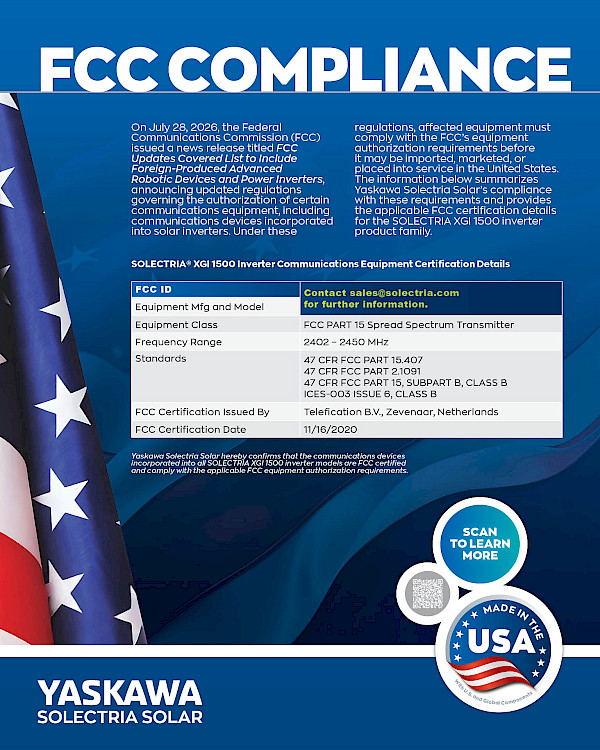
- FCC Compliance July 2026 - This information summarizes Yaskawa Solectria Solar’s compliance with these requirements and provides the applicable FCC certification details for the SOLECTRIA XGI 1500 inverter product family.
- Prohibited Foreign Entities Compliance - Meet tax credit qualifications with Yaskawa Solectria Solar
- Advancing Solar Power with Yaskawa Solectria Solar - SOLECTRIA® XGI 1500 Inverters and PowerRacks, the best PV inverters and storge solution for community solar
For further needs, or to request supporting documentation, please contact sales@solectria.com.
Inflation Reduction Act of 2022 (IRA)
The Inflation Reduction Act, enacted in August 2022, established significant federal incentives for renewable energy projects, including tax credits for solar energy facilities. The IRA also established a Domestic Content Bonus Credit, providing an additional tax credit incentive for projects that meet specified U.S. domestic content requirements for steel, iron and manufactured products. These requirements have become an important consideration in the selection and procurement of equipment for qualifying solar projects.
- IRS Notice 2023-38, issued in May 2023, provided the initial detailed guidance for determining whether a renewable energy project satisfies the IRA’s Domestic Content Bonus Credit requirements. The notice established the Steel or Iron Requirement and Manufactured Products Requirement, including rules for determining the percentage of manufactured-product costs attributable to U.S.-produced components. It also established certification and documentation requirements for taxpayers seeking the domestic content bonus credit.
- IRS Notice 2024-41, issued in May 2024, expanded and modified the Domestic Content guidance established in Notice 2023-38. The notice introduced an Elective Safe Harbor that allows taxpayers to use specified cost percentages for manufactured products and components when determining compliance with the Domestic Content Bonus Credit requirement. The notice also expanded the types of projects and components covered by the safe harbor.
- IRS Notice 2025-08, issued in January 2025, further updated the Domestic Content Safe Harbor established under Notice 2024-41. The updated guidance provides revised cost percentages and classifications for solar photovoltaic components, including inverters and other major equipment, and provides clarity for determining compliance with the Domestic Content requirement.
One Big Beautiful Bill Act
The One Big Beautiful Bill Act (OBBBA), enacted in July 2025, significantly changed the federal tax-credit requirements applicable to new solar projects, including requirements related to Domestic Content and Prohibited Foreign Entity (PFE) involvement. The law strengthens incentives for U.S.-manufactured equipment while imposing additional restrictions on projects that receive material assistance from PFEs. For solar projects seeking the federal Clean Electricity Investment Tax Credit under Section 48E or Production Tax Credit under Section 45Y, these requirements make the origin and content of major equipment increasingly important.
- IRS Notice 2025-42, issued in August 2025, established revised rules for determining when construction has begun on certain solar facilities for purposes of the federal clean electricity tax credits under Sections 45Y and 48E. The guidance significantly limits the circumstances under which the Five Percent Safe Harbor may be used and places greater emphasis on demonstrating actual physical work on a project. These requirements are important for projects seeking to preserve eligibility for federal clean-energy tax credits under the One Big Beautiful Bill Act.
- IRS Notice 2026-15, issued in February 2026, provides guidance concerning the Prohibited Foreign Entity (PFE) restrictions established the One Big Beautiful Bill Act. The notice establishes interim safe harbors and methods for determining whether a renewable-energy project contains prohibited levels of material assistance from a PFE. These requirements are intended to ensure that qualifying renewable energy projects do not rely on prohibited foreign sources to an extent that would affect eligibility for federal tax credits.
Buy American Act (BAA)
The Buy American Act (BAA), enacted in 1933, establishes domestic preference requirements for certain products and materials purchased directly by the federal government. In general, the BAA requires federal agencies to give preference to qualifying products manufactured in the United States and containing specified levels of Domestic Content. The requirements can apply to equipment supplied under qualifying federal contracts and procurements.
Build America, Buy America Act (BABA)
The Build America, Buy America Act (BABA), enacted as part of the Infrastructure Investment and Jobs Act of 2021, establishes Domestic Content requirements for infrastructure projects supported by federal financial assistance. Covered projects must use U.S.-produced iron, steel, manufactured products, and construction materials. BABA is particularly relevant to federally-funded infrastructure projects that incorporate solar energy equipment.
Federal Communications Commission (FCC)
On July 28, 2026, the Federal Communications Commission (FCC) added foreign-produced connected power inverters to its Covered List, following a federal national security determination that such equipment could present risks to U.S. national security and critical infrastructure. The action applies to solar inverters with communications, monitoring, sensing, data-collection, or remote-control capabilities and generally prevents new models of covered foreign-produced inverters from obtaining the FCC equipment authorization required for sale and use in the United States.
On August 20, 2026 the FCC tightened and clarified its new national-security restrictions on foreign-produced power inverters, including connected inverters that communicate through wired networks. The restriction primarily affects new FCC authorization of covered foreign-produced inverter models. Yaskawa Solectria Solar manufactures its XGI 1500 inverters in the United States at Yaskawa America's Buffalo Grove, Illinois manufacturing facility. Yaskawa America is eligible for and currently receives Section 45X advanced manufacturing production tax credits for the manufacture of the XGI 1500 inverters. Under the FCC's August 20, 2026 clarification, power inverters manufactured by entities eligible for Section 45X are not considered foreign-produced for purposes of the Covered List. Accordingly, the XGI 1500 is not subject to the FCC's restriction on foreign-produced power inverters.

